The programme of our ECREA Communication History Section workshop is now available.
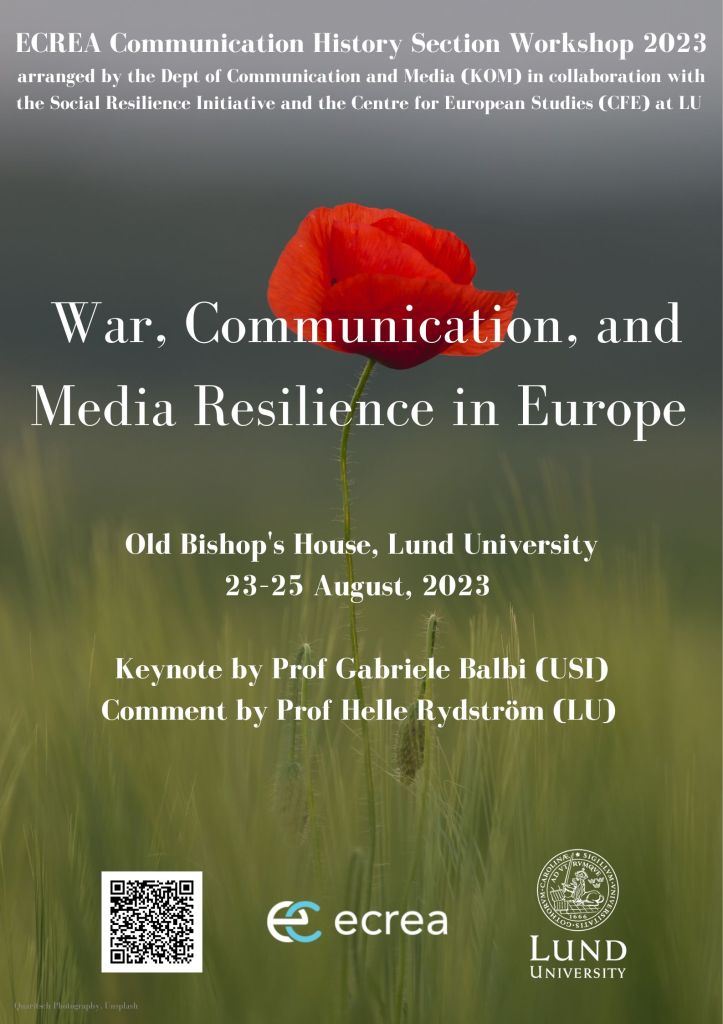

The programme of our ECREA Communication History Section workshop is now available.
Media are integral to how we both remember and forget conflict. While individuals refer to the family photo album, the collective memories of communities are often shaped by iconic photographs of traumatic events such as popular uprisings, terrorist attacks, and wars. This memory work was traditionally confined to repositories such as historical archives, museums and institutions. In recent years the ‘connective turn’ has ‘unmoored’ memory from these institutions, replacing traditional notions of collective memory with the searchable ‘memory of the multitude’ online (Hoskins, 2017). The automated systems of online platforms like Facebook ‘dig’ for memories on behalf of their users, including those of (Jacobsen and Beer, 2021). Historical photographs shared on photo sharing sites like Instagram facilitate informal learning about events such as the Holocaust among younger generations (Commane and Potton, 2019). This has empowered a new generation of memory activists who leverage the affordances of online platforms for commemoration rituals (Fridman, 2022). More recently, apps like Telegram have made it easier to document human rights violations during the Russian invasion of Ukraine, whilst simultaneously creating a curated, unsanitized ‘war feed’ for global audiences (Hoskins and Shchelin, 2023).
This hybrid workshop seeks to advance the discussion about the role of media in conflict memory work. We adopt a purposefully broad definition of conflict which includes (but is not limited to) armed insurrections, civil disorder, geopolitical interstate conflict, political violence in divided societies, terrorist attacks, and wars.
Continue readingThe Institute of Media and Journalism (IMeG) in the Faculty of Communication Sciences at USI (Università della Svizzera italiana) invites applications for 1 fully-funded PhD position (4 years), supervised by Prof. Gabriele Balbi. Upon successful completion of the program requirements, the candidate will earn a PhD in Communication Sciences.
The PhD position
PhD candidate will be expected to design and carry out research in the field of media and communication history, with a specific focus on maintenance of communication infrastructures and maintenance of media in diachronic perspective. Maintenance can be declined in different perspectives: politics of maintenance and the relation to power, economics and business of maintenance for private companies, the social construction of “maintenance cultures”, the persistence and longue durée of communication technologies because of maintenance, the lack of maintenance and the abandonment of communication infrastructures, and others. The candidates should advance their theoretical framework, timeframes, methodological angles, and case studies. They will be discussed during the interview and later can be refined and changed during the research.
The PhD should author and present papers at conferences and write a monography or cumulative PhD consisting of three peer reviewed journal articles.
She/he will also be expected to provide support for the activities at IMeG, including support for teaching, research projects, service, and organization of events. Specifically, the candidate will be engaged in the “Global Media and Internet Concentration Project”, of which the Institute is the Swiss partner (see https://search.usi.ch/it/progetti/2634/global-media-and-internet- concentration-project). (Read more in the file enclosed: deadline for application, candidate’s profile, etc. )
The Mahoney Prize recognizes an outstanding article in the history of computing and information technology, broadly conceived. The Mahoney Prize commemorates the late Princeton scholar Michael S. Mahoney, whose profound contributions to the history of computing came from his many articles and book chapters. The prize consists of a $500 award and a certificate. For the 2023 prize, articles published in the preceding three years (2020, 2021, and 2022) are eligible for nomination. The Mahoney Prize is awarded by the Special Interest Group in Computers, Information, and Society (SIGCIS) and is presented at the SIG’s annual meeting.
Please email copies of nomination articles to the 2023 Prize Committee by April 30, 2023. Please direct any questions to the 2023 committee chair, Kevin Driscoll.
2023 Mahoney Prize Committee:
Kevin Driscoll (Committee Chair), Associate Professor, Department of Media Studies, University of Virginia, ked5d@virginia.edu
Valérie Schafer, Professor, Contemporary European History, University of Luxembourg, valerie.schafer@uni.lu
Janet Toland, Associate Professor, School of Information Management, Victoria University of Wellington, janet.toland@vuw.ac.nz
Previous winners:
2022: Theodora Vardouli and David Theodore, “Walking Instead of Working: Space Allocation, Automatic Architecture, and the Abstraction of Hospital Labor,” in IEEE Annals of the History of Computing 43, no. 2 (April-June 2021): 6-17.
2021: Colette Perold, “IBM’s World Citizens: Valentim Bouças and the Politics of IT Expansion in Authoritarian Brazil,” IEEE Annals of the History of Computing42, no. 3 (July-September 2020): 38-52.
2020: Oliver Belcher. “Sensing, Territory, Population: Computation, Embodied Sensors, and Hamlet Control in the Vietnam War,” Security Dialogue 50.5, (2019) 416-436.
2019: Nikhil Menon. “‘Fancy Calculating Machine’: Computers and planning in independent India.” Modern Asian Studies 52, no. 2 (2018): 421-457.
2018: Joanna Radin. “Digital Natives: How Medical and Indigenous Histories Matter for Big Data.” Osiris Vol. 32, No. 1 (2017): 43-64
2017: Erica Robles-Anderson and Patrik Svensson, “’One Damn Slide After Another’: PowerPoint at Every Occasion for Speech.” Computational Culture (January 15, 2016).
2016: Andrew L. Russell and Valérie Schafer, “In the Shadow of ARPANET and Internet: Louis Pouzin and the Cyclades Network in the 1970s,” Technology and Culture 55, no. 4 (October 2014): 880-907.
2015: David Nofre, Mark Priestley, and Gerard Alberts, “When Technology Became Language: The Origins of the Linguistic Conception of Computer Programming, 1950-1960,” Technology and Culture 55 (January 2014): 40-75.
 ECREA Communication History Section